Level 2
The Beginning
...........................come in.............Those who have read from THe Beginning.................please feel free to ask any questions you have...............
The Beginning
...........................come in.............Those who have read from THe Beginning.................please feel free to ask any questions you have...............
Refraction
Note, n = 1 in a vacuum and n > 1 in a transparent substance, where n is the index of refraction.
When a beam of light crosses the boundary between a vacuum and another medium, or between two different media, the wavelength of the light changes, but the frequency remains constant. If the beam of light is not orthogonal (or rather normal) to the boundary, the change in wavelength results in a change in the direction of the beam. This change of direction is known as refraction.
The refractive quality of lenses is frequently used to manipulate light in order to change the apparent size of images. Magnifying glasses, spectacles, contact lenses, microscopes and refracting telescopes are all examples of this manipulation.
Light refraction is the main basis of measurement for gloss. Gloss is measured using a glossmeter, and an objects refractive index is what the glossmeter analyses.
................and the ready will enjoy their next.....which some will know as a beginning....and your breath?
Optics
The study of light and the interaction of light and matter is termed optics. The observation and study of optical phenomena such as rainbows and the aurora borealis offer many clues as to the nature of light as well as much enjoyment.
Light sources
There are many sources of light. The most common light sources are thermal: a body at a given temperature emits a characteristic spectrum of black-body radiation. Examples include sunlight (the radiation emitted by the chromosphere of the Sun at around 6,000 K peaks in the visible region of the electromagnetic spectrum when plotted in wavelength units [1] and roughly 40% of sunlight is visible), incandescent light bulbs (which emit only around 10% of their energy as visible light and the remainder as infrared), and glowing solid particles in flames. The peak of the blackbody spectrum is in the infrared for relatively cool objects like human beings. As the temperature increases, the peak shifts to shorter wavelengths, producing first a red glow, then a white one, and finally a blue color as the peak moves out of the visible part of the spectrum and into the ultraviolet. These colors can be seen when metal is heated to "red hot" or "white hot". Blue thermal emission is not often seen. The commonly seen blue colour in a gas flame or a welder's torch is in fact due to molecular emission, notably by CH radicals (emitting a wavelength band around 425 nm).
Atoms emit and absorb light at characteristic energies. This produces "emission lines" in the spectrum of each atom. Emission can be spontaneous, as in light-emitting diodes, gas discharge lamps (such as neon lamps and neon signs, mercury-vapor lamps, etc.), and flames (light from the hot gas itself—so, for example, sodium in a gas flame emits characteristic yellow light). Emission can also be stimulated, as in a laser or a microwave maser.
Deceleration of a free charged particle, such as an electron, can produce visible radiation: cyclotron radiation, synchrotron radiation, and bremsstrahlung radiation are all examples of this. Particles moving through a medium faster than the speed of light in that medium can produce visible Cherenkov radiation.
Certain chemicals produce visible radiation by chemoluminescence. In living things, this process is called bioluminescence. For example, fireflies produce light by this means, and boats moving through water can disturb plankton which produce a glowing wake.
Certain substances produce light when they are illuminated by more energetic radiation, a process known as fluorescence. Some substances emit light slowly after excitation by more energetic radiation. This is known as phosphorescence.
Phosphorescent materials can also be excited by bombarding them with subatomic particles. Cathodoluminescence is one example of this. This mechanism is used in cathode ray tube televisions.
Certain other mechanisms can produce light:
When the concept of light is intended to include very-high-energy photons (gamma rays), additional generation mechanisms include:
Light is measured with two main alternative sets of units: radiometry consists of measurements of light power at all wavelengths, while photometry measures light with wavelength weighted with respect to a standardized model of human brightness perception. Photometry is useful, for example, to quantify illumination intended for human use.
The photometry units are different from most systems of physical units in that they take into account how the human eye responds to light. The cone cells in the human eye are of three types which respond differently across the visible spectrum, and the cumulative response peaks at a wavelength of around 555 nm. Therefore, two sources of light which produce the same intensity (W/m2) of visible light do not necessarily appear equally bright. The photometry units are designed to take this into account, and therefore are a better representation of how "bright" a light appears to be than raw intensity. They relate to raw power by a quantity called luminous efficacy, and are used for purposes like determining how to best achieve sufficient illumination for various tasks in indoor and outdoor settings. The illumination measured by a photocell sensor does not necessarily correspond to what is perceived by the human eye, and without filters which may be costly, photocells and CCDs tend to respond to some infrared, ultraviolet or both.
In ancient India, the Hindu schools of Samkhya and Vaisheshika, from around the 6th–5th century BC, developed theories on light. According to the Samkhya school, light is one of the five fundamental "subtle" elements (tanmatra) out of which emerge the gross elements. The atomicity of these elements is not specifically mentioned and it appears that they were actually taken to be continuous.
On the other hand, the Vaisheshika school gives an atomic theory of the physical world on the non-atomic ground of ether, space and time. (See Indian atomism.) The basic atoms are those of earth (prthivı), water (apas), fire (tejas), and air (vayu), that should not be confused with the ordinary meaning of these terms. These atoms are taken to form binary molecules that combine further to form larger molecules. Motion is defined in terms of the movement of the physical atoms and it appears that it is taken to be non-instantaneous. Light rays are taken to be a stream of high velocity of tejas (fire) atoms. The particles of light can exhibit different characteristics depending on the speed and the arrangements of the tejas atoms. Around the first century BC, the Vishnu Purana refers to sunlight as the "the seven rays of the sun".
Later in 499, Aryabhata, who proposed a heliocentric solar system of gravitation in his Aryabhatiya, wrote that the planets and the Moon do not have their own light but reflect the light of the Sun.
The Indian Buddhists, such as Dignāga in the 5th century and Dharmakirti in the 7th century, developed a type of atomism that is a philosophy about reality being composed of atomic entities that are momentary flashes of light or energy. They viewed light as being an atomic entity equivalent to energy, similar to the modern concept of photons, though they also viewed all matter as being composed of these light/energy particles.
In the fifth century BC, Empedocles postulated that everything was composed of four elements; fire, air, earth and water. He believed that Aphrodite made the human eye out of the four elements and that she lit the fire in the eye which shone out from the eye making sight possible. If this were true, then one could see during the night just as well as during the day, so Empedocles postulated an interaction between rays from the eyes and rays from a source such as the sun.
In about 300 BC, Euclid wrote Optica, in which he studied the properties of light. Euclid postulated that light travelled in straight lines and he described the laws of reflection and studied them mathematically. He questioned that sight is the result of a beam from the eye, for he asks how one sees the stars immediately, if one closes one's eyes, then opens them at night. Of course if the beam from the eye travels infinitely fast this is not a problem.
In 55 BC, Lucretius, a Roman who carried on the ideas of earlier Greek atomists, wrote:
"The light & heat of the sun; these are composed of minute atoms which, when they are shoved off, lose no time in shooting right across the interspace of air in the direction imparted by the shove." - On the nature of the Universe
Despite being similar to later particle theories, Lucretius's views were not generally accepted and light was still theorized as emanating from the eye.
Ptolemy (c. 2nd century) wrote about the refraction of light in his book Optics, and developed a theory of vision whereby objects are seen by rays of light emanating from the eyes.[3]
The Muslim scientist Ibn al-Haytham (965–1040), known as Alhacen or Alhazen in the West, developed a broad theory of vision based on geometry and anatomy in his 1021 Book of Optics. Al-Haytham postulated that every point on an illuminated surface radiates light rays in all directions, but that only one ray from each point can be seen: the ray that strikes the eye perpendicularly. The other rays strike at different angles and are not seen. He described the pinhole camera and invented the camera obscura, which produces an inverted image, using it as an example to support his argument.[4] This contradicted Ptolemy's theory of vision that objects are seen by rays of light emanating from the eyes. Alhacen held light rays to be streams of minute energy particles[5] that travelled at a finite speed.[6][7][8] He improved Ptolemy's theory of the refraction of light, and went on to discover the laws of refraction.
He also carried out the first experiments on the dispersion of light into its constituent colors. His major work Kitab al-Manazir (Book of Optics) was translated into Latin in the Middle Ages, as well his book dealing with the colors of sunset. He dealt at length with the theory of various physical phenomena like shadows, eclipses, the rainbow. He also attempted to explain binocular vision, and gave an explanation of the apparent increase in size of the sun and the moon when near the horizon, known as the moon illusion. Because of his extensive experimental research on optics, Ibn al-Haytham is considered the "father of modern optics".[9]
Ibn al-Haytham also correctly argued that we see objects because the sun's rays of light, which he believed to be streams of tiny energy particles[5] travelling in straight lines, are reflected from objects into our eyes.[6] He understood that light must travel at a large but finite velocity,[6][7][8] and that refraction is caused by the velocity being different in different substances.[6] He also studied spherical and parabolic mirrors, and understood how refraction by a lens will allow images to be focused and magnification to take place. He understood mathematically why a spherical mirror produces aberration.
Avicenna (980–1037) agreed that the speed of light is finite, as he "observed that if the perception of light is due to the emission of some sort of particles by a luminous source, the speed of light must be finite."[10] Abū Rayhān al-Bīrūnī (973–1048) also agreed that light has a finite speed, and he was the first to discover that the speed of light is much faster than the speed of sound.[11] In the late 13th and early 14th centuries, Qutb al-Din al-Shirazi (1236–1311) and his student Kamāl al-Dīn al-Fārisī (1260–1320) continued the work of Ibn al-Haytham, and they were the first to give the correct explanations for the rainbow phenomenon.[11]
René Descartes (1596–1650) held that light was a disturbance of the plenum, the continuous substance of which the universe was composed. In 1637 he published a theory of the refraction of light that assumed, incorrectly, that light travelled faster in a denser medium than in a less dense medium. Descartes arrived at this conclusion by analogy with the behaviour of sound waves. Although Descartes was incorrect about the relative speeds, he was correct in assuming that light behaved like a wave and in concluding that refraction could be explained by the speed of light in different media. As a result, Descartes' theory is often regarded as the forerunner of the wave theory of light.
Ibn al-Haytham (Alhazen, 965–1040) proposed a particle theory of light in his Book of Optics (1021). He held light rays to be streams of minute energy particles[5] that travel in straight lines at a finite speed.[6][7][8] He states in his optics that "the smallest parts of light," as he calls them, "retain only properties that can be treated by geometry and verified by experiment; they lack all sensible qualities except energy."[5] Avicenna (980–1037) also proposed that "the perception of light is due to the emission of some sort of particles by a luminous source".[10]
Pierre Gassendi (1592–1655), an atomist, proposed a particle theory of light which was published posthumously in the 1660s. Isaac Newton studied Gassendi's work at an early age, and preferred his view to Descartes' theory of the plenum. He stated in his Hypothesis of Light of 1675 that light was composed of corpuscles (particles of matter) which were emitted in all directions from a source. One of Newton's arguments against the wave nature of light was that waves were known to bend around obstacles, while light travelled only in straight lines. He did, however, explain the phenomenon of the diffraction of light (which had been observed by Francesco Grimaldi) by allowing that a light particle could create a localised wave in the aether.
Newton's theory could be used to predict the reflection of light, but could only explain refraction by incorrectly assuming that light accelerated upon entering a denser medium because the gravitational pull was greater. Newton published the final version of his theory in his Opticks of 1704. His reputation helped the particle theory of light to hold sway during the 18th century. The particle theory of light led Laplace to argue that a body could be so massive that light could not escape from it. In other words it would become what is now called a black hole. Laplace withdrew his suggestion when the wave theory of light was firmly established. A translation of his essay appears in The large scale structure of space-time, by Stephen Hawking and George F. R. Ellis.
In the 1660s, Robert Hooke published a wave theory of light. Christiaan Huygens worked out his own wave theory of light in 1678, and published it in his Treatise on light in 1690. He proposed that light was emitted in all directions as a series of waves in a medium called the Luminiferous ether. As waves are not affected by gravity, it was assumed that they slowed down upon entering a denser medium.
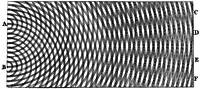
The wave theory predicted that light waves could interfere with each other like sound waves (as noted around 1800 by Thomas Young), and that light could be polarized, if it were a transverse wave. Young showed by means of a diffraction experiment that light behaved as waves. He also proposed that different colors were caused by different wavelengths of light, and explained color vision in terms of three-colored receptors in the eye.
Another supporter of the wave theory was Leonhard Euler. He argued in Nova theoria lucis et colorum (1746) that diffraction could more easily be explained by a wave theory.
Later, Augustin-Jean Fresnel independently worked out his own wave theory of light, and presented it to the Académie des Sciences in 1817. Simeon Denis Poisson added to Fresnel's mathematical work to produce a convincing argument in favour of the wave theory, helping to overturn Newton's corpuscular theory. By the year 1821, Fresnel was able to show via mathematical methods that polarization could be explained only by the wave theory of light and only if light was entirely transverse, with no longitudinal vibration whatsoever.
The weakness of the wave theory was that light waves, like sound waves, would need a medium for transmission. A hypothetical substance called the luminiferous aether was proposed, but its existence was cast into strong doubt in the late nineteenth century by the Michelson-Morley experiment.
Newton's corpuscular theory implied that light would travel faster in a denser medium, while the wave theory of Huygens and others implied the opposite. At that time, the speed of light could not be measured accurately enough to decide which theory was correct. The first to make a sufficiently accurate measurement was Léon Foucault, in 1850.[12] His result supported the wave theory, and the classical particle theory was finally abandoned.
In 1845, Michael Faraday discovered that the plane of polarization of linearly polarized light is rotated when the light rays travel along the magnetic field direction in the presence of a transparent dielectric, an effect now known as Faraday rotation.[13] This was the first evidence that light was related to electromagnetism. In 1846 he speculated that light might be some form of disturbance propagating along magnetic field lines.[14] Faraday proposed in 1847 that light was a high-frequency electromagnetic vibration, which could propagate even in the absence of a medium such as the ether.
Faraday's work inspired James Clerk Maxwell to study electromagnetic radiation and light. Maxwell discovered that self-propagating electromagnetic waves would travel through space at a constant speed, which happened to be equal to the previously measured speed of light. From this, Maxwell concluded that light was a form of electromagnetic radiation: he first stated this result in 1862 in On Physical Lines of Force. In 1873, he published A Treatise on Electricity and Magnetism, which contained a full mathematical description of the behaviour of electric and magnetic fields, still known as Maxwell's equations. Soon after, Heinrich Hertz confirmed Maxwell's theory experimentally by generating and detecting radio waves in the laboratory, and demonstrating that these waves behaved exactly like visible light, exhibiting properties such as reflection, refraction, diffraction, and interference. Maxwell's theory and Hertz's experiments led directly to the development of modern radio, radar, television, electromagnetic imaging, and wireless communications.
The special theory of relativity
The wave theory was wildly successful in explaining nearly all optical and electromagnetic phenomena, and was a great triumph of nineteenth century physics. By the late nineteenth century, however, a handful of experimental anomalies remained that could not be explained by or were in direct conflict with the wave theory. One of these anomalies involved a controversy over the speed of light. The constant speed of light predicted by Maxwell's equations and confirmed by the Michelson-Morley experiment contradicted the mechanical laws of motion that had been unchallenged since the time of Galileo, which stated that all speeds were relative to the speed of the observer. In 1905, Albert Einstein resolved this paradox by revising the Galilean model of space and time to account for the constancy of the speed of light. Einstein formulated his ideas in his special theory of relativity, which radically altered humankind's understanding of space and time. Einstein also demonstrated a previously unknown fundamental equivalence between energy and mass with his famous equation
where E is energy, m is rest mass, and c is the speed of light in a vacuum.
Another experimental anomaly was the photoelectric effect, by which light striking a metal surface ejected electrons from the surface, causing an electric current to flow across an applied voltage. Experimental measurements demonstrated that the energy of individual ejected electrons was proportional to the frequency, rather than the intensity, of the light. Furthermore, below a certain minimum frequency, which depended on the particular metal, no current would flow regardless of the intensity. These observations clearly contradicted the wave theory, and for years physicists tried in vain to find an explanation. In 1905, Einstein solved this puzzle as well, this time by resurrecting the particle theory of light to explain the observed effect. Because of the preponderance of evidence in favor of the wave theory, however, Einstein's ideas were met initially by great skepticism among established physicists. But eventually Einstein's explanation of the photoelectric effect would triumph, and it ultimately formed the basis for wave–particle duality and much of quantum mechanics.
A third anomaly that arose in the late 19th century involved a contradiction between the wave theory of light and measurements of the electromagnetic spectrum emitted by thermal radiators, or so-called black bodies. Physicists struggled with this problem, which later became known as the ultraviolet catastrophe, unsuccessfully for many years. In 1900, Max Planck developed a new theory of black-body radiation that explained the observed spectrum correctly. Planck's theory was based on the idea that black bodies emit light (and other electromagnetic radiation) only as discrete bundles or packets of energy. These packets were called quanta, and the particle of light was given the name photon, to correspond with other particles being described around this time, such as the electron and proton. A photon has an energy, E, proportional to its frequency, f, by
where h is Planck's constant, λ is the wavelength and c is the speed of light. Likewise, the momentum p of a photon is also proportional to its frequency and inversely proportional to its wavelength:
As it originally stood, this theory did not explain the simultaneous wave- and particle-like natures of light, though Planck would later work on theories that did. In 1918, Planck received the Nobel Prize in Physics for his part in the founding of quantum theory.
The modern theory that explains the nature of light includes the notion of wave–particle duality, described by Albert Einstein in the early 1900s, based on his study of the photoelectric effect and Planck's results. Einstein asserted that the energy of a photon is proportional to its frequency. More generally, the theory states that everything has both a particle nature and a wave nature, and various experiments can be done to bring out one or the other. The particle nature is more easily discerned if an object has a large mass, and it was not until a bold proposition by Louis de Broglie in 1924 that the scientific community realized that electrons also exhibited wave–particle duality. The wave nature of electrons was experimentally demonstrated by Davission and Germer in 1927. Einstein received the Nobel Prize in 1921 for his work with the wave–particle duality on photons (especially explaining the photoelectric effect thereby), and de Broglie followed in 1929 for his extension to other particles.
The quantum mechanical theory of light and electromagnetic radiation continued to evolve through the 1920s and 1930's, and culminated with the development during the 1940s of the theory of quantum electrodynamics, or QED. This so-called quantum field theory is among the most comprehensive and experimentally successful theories ever formulated to explain a set of natural phenomena. QED was developed primarily by physicists Richard Feynman, Freeman Dyson, Julian Schwinger, and Shin-Ichiro Tomonaga. Feynman, Schwinger, and Tomonaga shared the 1965 Nobel Prize in Physics for their contributions.
Light pushes on objects in its path, just as the wind would do. This pressure is most easily explainable in particle theory: photons hit and transfer their momentum. Light pressure can cause asteroids to spin faster,[15] acting on their irregular shapes as on the vanes of a windmill. The possibility to make solar sails that would accelerate spaceships in space is also under investigation.[16][17]
Although the motion of the Crookes radiometer was originally attributed to light pressure, this interpretation is incorrect; the characteristic Crookes rotation is the result of a partial vacuum.[18] This should not be confused with the Nichols radiometer, in which the motion is directly caused by light pressure.[19]
The sensory perception of light plays a central role in spirituality (vision, enlightenment, darshan, Tabor Light). The presence of light as opposed to its absence (darkness) is a common Western metaphor of good and evil, knowledge and ignorance, and similar concepts.
Optics is the study of the behavior and properties of light, including its interactions with matter and the construction of instruments that use or detect it.[1] Optics usually describes the behavior of visible, ultraviolet, and infrared light. Because light is an electromagnetic wave, other forms of electromagnetic radiation such as X-rays, microwaves, and radio waves exhibit similar properties.[1]
Optics is regarded within theoretical physics as a subfield of electromagnetism, and the vast majority of optical phenomena can be accounted for using the classical electromagnetic description of light. Complete electromagnetic descriptions of light are often difficult to apply in practice, however, so practical optics is usually done using simplified models. The most common of these, geometric optics, treats light as a collection of rays that travel in straight lines and bend when they pass through or reflect from surfaces. Physical optics is a more comprehensive model of light, which includes wave effects such as diffraction and interference that cannot be accounted for in geometric optics.
Not all optical phenomena can be treated using classical electromagnetism. Some phenomena depend on the fact that light has both wave-like and particle-like properties. Explanation of these effects requires quantum mechanics. In quantum mechanics, light is treated as a collection of particles called photons. Quantum optics deals with the application of quantum mechanics to optical systems.
..................Is our name not as powerful as a index finger? ??..............Let us use the minds eye for a clear picture...
Bless
Some sources add
Of these nine or ten opposites, many philosophers have seized on the third pair as one of the most profound questions in philosophy. Is the universe one? Then how is it diverse? Is the universe many? Then how is it unified? This is called the problem of the one and the many, about which no small amount of ink has been spilled.
.................Im glad we all are going "green" by typing on this blog.....lol ![]()
...Let us learn from our past and start at THe Beginning........Even a sightless person can control a bumpercar.......?
and If we can keep our breath in our awarness...as we have for the past month... I know we together will continue to plant new fields.
We have traveled far, and I know some of us need a rest. I will gather those who have fallen behind, and direct them all to
http://mind.impulsedriven.net ......so they may have all the tools of this degree... For u must learn to GivE before U Receive?
U ask why?....................lol
C U next time?
Bless
..... R we on the same page?
....Did you read....?
You forgot your breath?........again?
no more talking ............. read/rest...
A doctor who specializes in skin diseases will dream that he has fallen asleep in front of the television. Later, he will wake up in front of the television, but not remember his dream.
.....If a traveler has no summary of the 1st, ...what can a summary of the second truly hold?.................. For some much, and for even more less.
......Go all the way back to the first blog "THe Beginning" .read...understand...overstand...share...and then we shall all meet again here on the level.
..We are timeless in our reading, so it will be here in the minds "I"...........that we will join together in unity.
THe "stronger" helping the "weaker"..........as a parent to a child. Each step of our travel.....servers a grand purpose.....every movement required
for even the smallest task.
This thread is connected to us all..... and so is THe Beginning... Let u start there so u can make better "use" of your time.
...P.s Do your forget your breath often? If so.....u will
"Later, wake up in front of the television, but not remember your dream".
Bless
....Does the child not help the parent..... by being obedient....................?
.................Is there duality.................?
-------------> THe Beginning
bless
False cognates are pairs of words in the same or different languages that are similar in form and meaning but have different roots. That is, they appear to be or are sometimes considered cognates when in fact they are not. Note that even false cognates may have an indirect connection between them, even if they lack a common root.
As an example of false cognates, the word for "dog" in the Australian Aboriginal language Mbabaram happens to be dog, although there is no common ancestor or other connection between that language and English (the Mbabaram word evolved regularly from a protolinguistic form *gudaga). Similarly, in the Japanese language the word 'to occur' happens to be okoru.
The basic kinship terms mama and papa comprise a special case of false cognates (cf. !Kung ba, Chinese bàba, Persian baba, and French papa (all "dad"); or Navajo má, Chinese māma, Swahili mama, Quechua mama, and English "mama"). The striking cross-linguistical similarities between these terms are thought to result from the nature of language acquisition (Jakobson 1962). According to Jakobson, these words are the first word-like sounds made by babbling babies; and parents tend to associate the first sound babies make with themselves. Thus, there is no need to ascribe the similarities to common ancestry. This hypothesis is supported by the fact that these terms are built up from speech sounds that are easiest to produce (bilabial stops like m and b and the basic vowel a). However, variants do occur; for example, in Fijian, the word for "mother" is nana, and in proto-Old Japanese, the word for "mother" was *papa. Furthermore, the modern Japanese word for "father," chichi, is from older titi. In fact, in Japanese the child's initial mamma is interpreted to mean "food". Similarly, in some Indian languages, such as Marathi, a child's articulation of "mum-mum" is interpreted to mean "food".
The term "false cognate" is sometimes misused to describe false friends. One difference between false cognates and false friends is that while false cognates mean roughly the same thing in two languages, false friends bear two distinct (sometimes even opposite) meanings. In fact, a pair of false friends may be true cognates (see false friends: causes).
A related phenomenon is the expressive loan, which looks like a native construction, but is not.
Some historical linguists presume that all languages go back to a single common ancestor. Therefore, a pair of words whose earlier forms are distinct, yet similar, as far back as they've been traced, could in theory have come from a common root in an even earlier language, making them real cognates. The further back in time language reconstruction efforts go, however, the less confidence there can be in the outcome. Attempts at such reconstructions typically rely on just such pairings of superficially similar words, but the connections proposed by these theories tend to be conjectural, failing to document significant patterns of linguistic change. Under the disputed Nostratic theory and similar theories, some of these examples would indeed be distantly related cognates, but the evidence for reclassifying them as such is insufficient. The Nostratic hypothesis is however based on the comparative method, unlike some other superfamily hypotheses.
Many criticisms of the basic assumptions of generative theory have been put forth, with little response from its champions. The concept of a Language Acquisition Device (LAD) is unsupported by evolutionary anthropology, which shows a gradual adaptation of the human body to the use of language, rather than a sudden appearance of a complete set of binary parameters (which are common to digital computers but not to neurological systems such as a human brain) delineating the whole spectrum of possible grammars ever to have existed and ever to exist.
The theory has several hypothetical constructs, such as movement, empty categories, complex underlying structures, and strict binary branching, that cannot possibly be acquired from any amount of input. Since the theory is, in essence, unlearnably complex, then it must be innate. A different theory of language, however, may yield different conclusions. Examples of alternative theories that do not utilize movement and empty categories are head-driven phrase structure grammar, lexical functional grammar, and several varieties of construction grammar. While all theories of language acquisition posit some degree of innateness, a less convoluted theory might involve less innate structure and more learning. Under such a theory of grammar, the input, combined with both general and language-specific learning capacities, might be sufficient for acquisition.
.......................There is knowledge?
"He brought them to the man to see what he would name them"
...oh travelers, should we not watch our mouths? For we all are created for a good purpose... and have all the "......" needed.... for we are truly
ready....
prepared in the manner after our father who was before us....
bless
"It is better to remain silent and be thought a fool, then to open your mouth and remove all doubts."......................There is knowledge here...................
Prana is a Sanskrit word which is difficult to translate directly, since it encompasses a variety of ideas and concepts. Essentially, it would be taken to mean “energy” or “life force,” but these definitions do not quite do justice to the word. Prana is also associated with breath, although air itself is not prana; rather, breathing can be used to focus and control prana as part of a spiritual practice. This life force ebbs and flows through the body.
Prana (प्राण, prāṇa) is the Sanskrit for "breath" (from the root prā "to fill", cognate to Latin plenus "full"). It is one of the five organs of vitality or sensation, viz. prana "breath", vac "speech", caksus "sight", shrotra "hearing", and manas "thought" (nose, mouth, eyes, ears and mind; ChUp. 2.7.1).
In Vedantic philosophy, it is the notion of a vital, life-sustaining force of living beings and vital energy, comparable to the Chinese notion of Qi. Prana is a central concept in Ayurveda and Yoga where it is believed to flow through a network of fine subtle channels called nadis. Its most subtle material form is the breath, but is also to be found in blood, and its most concentrated form is semen in men and vaginal fluid in women.[1] The Pranamaya-kosha is one of the five Koshas or "sheaths" of the Atman.
Prana was first expounded in the Upanishads, where it is part of the worldly, physical realm, sustaining the body and the mother of thought and thus also of the mind. Prana suffuses all living forms but is not itself the Atman or individual soul. In the Ayurveda, the Sun and sunshine are held to be a source of Prana.The Five Pranas
In Ayurveda, the Prana is further classified into subcategories, referred to as pranas. According to Hindu philosophy these are the vital principles of basic energy and subtle faculties of an individual that sustain physiological processes. There are five pranas or vital currents in the Hindu system:[3]
Pranayama is the practice in which the control of prana is achieved (initially) from the control of one's breathing. According to Yogic philosophy the breath, or air, is merely a gateway to the world of prana and its manifestation in the body. In yoga, pranayama techniques are used to control the movement of these vital energies within the body, which is said to lead to an increase in vitality in the practitioner [4][citation needed]. However, intensive practice [5] of these techniques is not trivial. Kason [6] describes situations where intensive pranayama techniques may have adverse effects on certain practitioners.
Advanced Spiritual Chakra System
Chakra 12 - Connection to the Monadic level of divinity, advanced spiritual skills, ascension, connection to the cosmos and beyond
Chakra 11 - Pathwork to the Soul, the individual's ability to acquire advanced spiritual skills (travel beyond the limits of time and space, teleprotation, bi-location, instantaneous precipitation of thoughts, telekinesis in some cases)
Chakra 10 - divine creativity, synchronicity of life; the merging of the masculine and feminine within, unlocking of skills contained in the ninth chakra
Chakra 9 - soul blueprint (the individual's total skills and abilities learned in all the life times)
Chakra 8 - energy center of divine love, of spiritual compassion and spiritual selflessness, your karmic residue, activates spiritual skills contained in the seventh chakra,
Chakra 7 - (crown chakra) Traditionally your connection to the divine (Atmic level of divinity), contains programs to be used by 8th chakra including the release of basic psychic skills (telepathy, seeing aura, lucid dreaming, out of body travel, healing)
................There is knowledge here............
For it would seem to the naked eye, that 1 must first transend the physical, in order for the body to enjoy complete freedom of movement....
....We welcome u all....
bless
Prana: What is Prana?
Prana or ki is that life energy which keeps the body alive and healthy. In Greek it is called 'pneuma', in Polynesian 'mana', and in Hebrew 'ruah', which means 'breath of life'. The healer projects prana or life energy or 'the breath of life' to the patient, thereby, healing the patient. It is through this process that this so-called 'miraculous healing' is accomplished.
Basically, there are three major sources of prana: solar prana, air prana and ground prana:
Solar Prana
Solar prana is prana from sunlight. It invigorates the whole body and promotes good health. It can be obtained by sunbathing or exposure to sunlight for about five to ten minutes and by drinking water that has been exposed to sunlight. Prolonged exposure or too much solar prana would harm the whole physical body since it is quite potent.
Prana contained in the air is called air prana or air vitality globule. Air prana is absorbed by the lungs through breathing and is also absorbed directly by the energy centers of the bioplasmic body. These energy centers are called chakras. More air prana can be absorbed by deep slow rhythmic breathing than by short shallow breathing. It can also be absorbed through the pores of the skin by persons who have undergone certain training.
Ground Prana
Prana contained in the ground is called ground prana or ground vitality globule. This is absorbed through the soles of the feet. This is done automatically and unconsciously. Walking barefoot increases the amount of ground prana absorbed by the body. One can learn to consciously draw in more ground prana to increase one's vitality, capacity to do more work, and ability to think more clearly.
Water Prana
Water absorbs prana from sunlight, air, and ground that it comes in contact with. Plants and trees absorb prana from sunlight, air, water, and ground. Men and animals obtain prana from sunlight, air, ground, water, and food. Fresh food contains more prana than preserved food.
Prana for healing
Prana can also be projected to another person for healing. Persons with a lot of excess prana tend to make other people around them feel better and livelier. However, those who are depleted tend to unconsciously absorb prana from other people. You may have encountered persons who tend to make you feel tired or drained for no apparent reason at all.
Prana in nature
Certain trees, such alpine trees or old and gigantic healthy trees, exude a lot of excess prana. Tired or sick people benefit much by lying down or resting underneath these trees. Better results can be obtained by verbally requesting the being of the tree to help the sick person get well. Anyone can also learn to consciously absorb prana from these trees through the palms, such that the body would tingle and become numb because of the tremendous amount of prana absorbed. This skill can be acquired after only a few sessions of practice.
Power places
Certain areas or places tend to have more prana than others. Some of these highly energized areas tend to become healing centers.
Weather
During bad weather conditions, many people get sick not only because of the changes in temperature but also because of the decrease in solar and air prana (life energy). Thus, a lot of people feel mentally and physically sluggish or become susceptible to infectious diseases. This can be counteracted by consciously absorbing prana or ki from the air and the ground. It has been clairvoyantly observed that there is more prana during daytime than at night. Prana reaches a very low level at about three or four in the morning.
..........................Let us find our center and focus on our breath...................
.....Let us all go back 2 THe Beginning..... and find someone to help along...
1 is all that is needed for Fun
2 is when u notice the different things U Do
3 is for those of who Disagree but Agree to remain Free
4 is for those who need less but desire more, only Receiving War
5 is for Live, unity is what they strive, building in the vacant, harmoniuous as a bee hive
6 is for Bricks, trading in my self grown straw, and using the sticks to burn on the fire, Truthful with myself to myself no more a lier
7 is for my thoughts of heaven, squaring my base from infinity, while reaching for eleven
8 is for the date, for in your mind it is to late to wait, so U motivate
9 is where u "toe the line", putting all things behind
10 U become master, so U do it again
...THERE is knowledge here for WHO...
...I AM FILLED...
bless
....Welcome, if you are here for the first time... we welcome you to the front door http://mind.impulsedriven.net so that you may start at THe
Beginning.
......ok.......So you have read from THe Beginning..................?
Then welcome, let us start out by placing our focus on our breath.................................... now let us travel into the word...
An example is the interaction between beliefs and observations in a marketplace: if traders believe that prices will fall, they will sell - thus driving down prices, whereas if they believe prices will rise, they will buy - thereby driving prices up. [1]
In social theory, reflexivity may occur when theories in a discipline should apply equally forcefully to the discipline itself, for example in the case that the theories of knowledge construction in the field of Sociology of Scientific Knowledge should apply equally to knowledge construction by Sociology of Scientific Knowledge practitioners, or when the subject matter of a discipline should apply equally well to the individual practitioners of that discipline, for example when psychological theory should explain the psychological mental processes of psychologists. More broadly, reflexivity is considered to occur when the observations or actions of observers in the social system affect the very situations they are observing, or theory being formulated is disseminated to and affects the behaviour of the individuals or systems the theory is meant to be objectively modelling. Thus for example an anthropologist living in an isolated village may affect the village and the behaviour of its citizens that he or she is studying. The observations are not independent of the participation of the observer.
Reflexivity is, therefore, a methodological issue in the social sciences analogous to the observer principle. Within that part of recent sociology of science that has been called the strong programme, reflexivity is suggested as a methodological norm or principle, meaning that a full theoretical account of the social construction of, say, scientific, religious or ethical knowledge systems, should itself be explainable by the same principles and methods as used for accounting for these other knowledge systems. This points to a general feature of naturalised epistemologies, that such theories of knowledge allows for specific fields of research to elucidate other fields as part of an overall self-reflective process: Any particular field of research occupied with aspects of knowledge processes in general (e.g., history of science, cognitive science, sociology of science, psychology of perception, semiotics, logic, neuroscience) may reflexively study other such fields yielding to an overall improved reflection on the conditions for creating knowledge.
Reflexivity includes both a subjective process of self-consciousness inquiry and the study of social behavior with reference to theories about social relationships.
The principle of reflexivity was perhaps first enunciated by the sociologist William Thomas (1923, 1928) as the Thomas theorem: that 'the situations that men define as true, become true for them.'
Sociologist Robert K. Merton (1948, 1949) built on the Thomas principle to define the notion of a self-fulfilling prophecy: that once a prediction or prophecy is made, actors may accommodate their behaviours and actions so that a statement that would have been false becomes true or, conversely, a statement that would have been true becomes false - as a consequence of the prediction or prophecy being made. The prophecy has a constitutive impact on the outcome or result, changing the outcome from what would otherwise have happened.
Reflexivity was taken up as an issue in science in general by Popper (1957), who called it the 'Oedipal effect', and more comprehensively by Nagel (1961). Reflexivity presents a problem for science because if a prediction can lead to changes in the system that the prediction is made in relation to, it becomes difficult to assess scientific hypotheses by comparing the predictions they entail with the events that actually occur. The problem is even more difficult in the social sciences.
Reflexivity has been taken up as the issue of "reflexive prediction" in economic science by Grunberg and Modigliani (1954) and Herbert Simon (1954), has been debated as a major issue in relation to the Lucas Critique, and has been raised as a methodological issue in economic science arising from the issue of reflexivity in the Sociology of Scientific Knowledge (SSK) literature.
Reflexivity has emerged as both an issue and a solution in modern approaches to the problem of structure and agency, for example in the work of Anthony Giddens in his structuration theory and Pierre Bourdieu in his genetic structuralism.
Giddens, for example, noted that constitutive reflexivity is possible in any social system, and that this presents a distinct methodological problem for the social sciences. Giddens accentuated this theme with his notion of "reflexive modernity" - the argument that, over time, society is becoming increasingly more self-aware, reflective, and hence reflexive.
Bourdieu argued that the social scientist is inherently laden with biases, and only by becoming reflexively aware of those biases can the social scientists free themselves from them and aspire to the practice of an objective science. For Bourdieu, therefore, reflexivity is part of the solution, not the problem.
Michel Foucault's The Order of Things can be said to touch on the issue of Reflexivity. Foucault examines the history of western thought since the Renaissance and argues that each historical epoch (he identifies 3, while proposing a 4th) has an episteme, or "a historical a priori", that structures and organizes knowledge. Foucault argues that the concept of man emerged in the early 19th century, what he calls the "Age of Man", with the philosophy of Immanuel Kant. He finishes the book by posing the problem of the age of man and our pursuit of knowledge- where "man is both knowing subject and the object of his own study"; thus, Foucault argues that the social sciences, far from being objective, produce truth in their own mutually exclusive discourses.
Billionaire investor George Soros has been an active promoter of the relevance of reflexivity to economics first propounding it publicly in his 1987 book. [2]
Reflexivity is discordant with equilibrium theory, which stipulates that markets move towards equilibrium and that non-equilibrium fluctuations are merely random noise that will soon be corrected. In equilibrium theory, prices in the long run at equilibrium reflect the underlying fundamentals, which are unaffected by prices. Reflexivity asserts that prices do in fact influence the fundamentals and that these newly-influenced set of fundamentals then proceed to change expectations, thus influencing prices; the process continues in a self-reinforcing pattern. Because the pattern is self-reinforcing, markets tend towards disequilibrium. Sooner or later they reach a point where the sentiment is reversed and negative expectations become self-reinforcing in the downward direction, thereby explaining the familiar pattern of boom and bust cycles [3]
Flanagan (1981) and others have argued that reflexivity complicates all three of the traditional roles that are typically played by a classical science: explanation, prediction and control.
The fact that individuals and social collectivities are capable of self-inquiry and adaptation is a key characteristic of real-world social systems, differentiating the social sciences from the physical sciences.
Reflexivity, therefore, raises real issues regarding the extent to which the social sciences may ever be 'hard' sciences analogous to classical physics, and raises questions about the nature of the social sciences.
.......Are we still thinking about our breath? If no, then should we not venture back to THe Beginning and retrace...
THERE is KNowledge here....as well as hidden keys to wealth.
Is rich....wealth? R they hand in hand?..............Start from where u should, and enjoy every moment. Doing good "now" instead of
placing responsibility upon your future self...
Procrastination?
Procrastination is the art of wasting time, the only thing that really matters in the end. Wasting time is wasting life... it is wasting breath.
WE as you refer to are not the same as WE were a THe Beginning, because WE were unaware.... and now WE are unaware and older... as far as time can be used to judge the length of existence.
..................Now there is Knowledge here........?...... and i was not alone in knowing its location......
let us harvest.
....And for those who have the "time".... follow us...
to THe Beginning
Look yngmon, I'm going to be civil for a change about this.
You may think is cool because it's weird/different. Maybe thats the way you are or like to do things. This thread is fairly unique (at least on these forums). But let me put the ugly truth forward: Moderators will consider this to be spam. I'm sorry but it's true. I'm suprised a moderator hasn't stumbled upon this yet and locked it. I mean, your posting fairly random things. And all that text you copy and paste from Wikipedia and the like has GOT to be a huge drain on the servers.
If there is a point to this, I'd recommend that you quickly sum it up. You can listen to me or not, but in time, this thread will get closed because of the reason I just told you.
Etrius
Elitism is the belief or attitude that those individuals who are considered members of the elite—a select group of people with outstanding personal abilities, intellect, wealth, specialized training or experience, or other distinctive attributes—are those whose views on a matter are to be taken the most seriously or carry the most weight or those who view their own views as so; whose views and/or actions are most likely to be constructive to society as a whole; or whose extraordinary skills, abilities or wisdom render them especially fit to govern. Alternatively, the term elitism may be used to describe a situation in which power is concentrated in the hands of the elite. Those opposed to elitism are considered supporters of anti-elitism, populism or the political theory of pluralism. Elite theory is the sociological or political science analysis of elite influence in society - elite theorists regard pluralism as a utopian ideal.
Elitism may also refer to situations in which an elite individual assumes special privileges and responsibilities in the hope that this arrangement will benefit humanity or themselves. At times, elitism is closely related to social class and what sociologists call social stratification. Members of the upper classes are sometimes, though inaccurately, known as the social elite. The term elitism is also sometimes used to denote situations in which a group of people claiming to possess high abilities or simply an in-group or cadre grant themselves extra privileges at the expense of others. This form of elitism may be described as discrimination. Such elitism has social psychological consequences.
Characteristics
Attributes that identify an elite vary; personal achievement may not be essential. As a term "Elite" usually describes a person or group of people who are members of the uppermost class of society and wealth can contribute to that class determination. Personal attributes commonly purported by elitist theorists to be characteristic of the elite include: rigorous study of, or great accomplishment within, a particular field; a long track record of competence in a demanding field; an extensive history of dedication and effort in service to a specific discipline (e.g., medicine or law) or a high degree of accomplishment, training or wisdom within a given field.
Some synonyms for elite might be "Upper-class," or "Aristocratic," indicating that the individual in question has a relatively large degree of control over a society's means of production. This includes those who gain this position due to socioeconomic means and not personal achievement.
Academic elitism
Main article: Academic elitism
Elitism in the context of education is the practice of concentrating attention on or allocating funding to the best students, or those students who rank highest in a particular field of endeavour. For example, a politician who promotes specialized biochemistry classes for students deemed by conventional structures to be highly intelligent in an effort to cure diseases might be accused of elitism. Elitism in education could be based upon conventional assessment of learning ability, knowledge, or other abilities. An elite school could merely be a wealthy school or an old school.
Anti-elitism
The term elitism or the title elitist are sometimes used resentfully by people who are (or claim to be) not a member of an elite. In politics, the terms are often used to describe people as out of touch with the Average Joe. The implication is that the alleged elitist person or group thinks they are better than everyone else, and therefore put themselves before others. It could be seen as a synonym for snob. An elitist is not always seen as truly elite, but only privileged. This use is often employed in politics in societies where social equality is valued and the middle and lower classes have political power.
Egalitarianism
Elitism endorses the exclusion of large numbers of people from positions of privilege or power. Thus, many populists seek the social equality of egalitarianism, populism, socialism, or communism. They may also support affirmative action, social security, luxury taxes, and increasingly high progressive taxes for the wealthiest members of society. All of these measures seek to reduce the gap of power between the elite and the ordinary.
Pluralism
Pluralism is the belief that public policy decisions should be (or, descriptively, are) the result of the struggle of forces exerted by large populations (workers, consumers, retirees, parents, etc.) directly or indirectly in the policy-making process. This is contrasted with elitism which is the belief that decisions should be (or are being) made essentially according to the interests or ideas of elites. There is a difference, however, between the idea of being more able to fulfill a political task and the actual knowing of the specialization and specifications of each corporation or other group among the general population and its particular hopes and needs, which suggests a way of cooperation which has been recently put into practice in some countries between politicians and groups of citizens which have some remote resemblances to corporatism.
.... the world is illusion.... there is only brahma.... brahma is the world....
You crack me up Fuzzy. ![]()
The real illusion is if there is an illusion at all....
Brahma is creation, the father of human existence
Welcome Guest! Please take the time to register with us.